The Scarlet Letter

The Scarlet Letter

Sunday, March 8, 2015

Reader Reaction Chapter 23-24

Reader Reaction Chapter 23-24

The ending of this novel was sweet and the last chapter was maybe a little unnecessary. Dimmesdale finally confesses about his sin upon the scaffold. He reveals the scarlet letter that he has imprinted on his own flesh. This was due to the shame he had to bear. His action and confession finally sets Hester and Pearl free. Hester now has freedom in her life, with the opportunity to live outside the harshness of society. She can seek give peace with her own heart. She dies alone, but can die mostly happy. She has fulfilled not only her duties, but also her love, ensuring that her daughter will continue her legacy.

Ending with Dimmesdale’s confession and death could have sufficed. The last chapter basically told the aftermath of the climax. Years later, Hester Prynne goes back to the society that shunned her for so long. She goes back to her cottage on the outskirts of town. She goes back to wearing her scarlet letter. Even though she is free, her adultery makes her feel bound. It has become a part of her. She can't actually feel free unless she's atoning by wearing the A.

The novel leaves us with a final picture of Hester and Dimmesdale's gravestone. They have been buried near one another but not directly next to each other. “And, after many, many years, a new grave was delved, near an old and sunken one, in that burial-ground beside which King’s Chapel has since been built. It was near that old and sunken grave, yet with a space between, as if the the dust of the two sleepers had no right to mingle. Yet one tombstone served for both” (Hawthorne 235). If Hester and Dimmesdale can be buried near each other, it suggests that the community has, in many ways, forgiven them for their adultery. The Puritan society has come a long way from the start of the novel. They had ostracized Hester, but eventually came to terms with her. They were able to partially forgive the sin, since Hester and Dimmesdale are in the same tombstone.

“But there was a more real life for Hester Prynne here, in New England, than in that unknown region where Pearl had found a home. Here had been her sin; here, her sorrow; and here was yet to be her penitence. She had returned, therefore, and resumed,—of her own free will, for not the sternest magistrate of that iron period would have imposed it,—resumed the symbol of which we have related so dark a tale” (Hawthorne 234). This passage concludes the book’s exploration of the theme of individual identity contradicting with social judgments. After being gone for many years, Hester has returned to her former home. She resumes wearing the scarlet letter because she feels her past is an important part of her identity. She has overcome adversity and has gained numerous life experiences. The letter is a symbol for all that. She now has her own identity, and can be seen as an example for others. She is an example of restitution.

My gossamer thread is about the motif of secrecy in The Little Prince. This motif can also be seen in The Scarlet Letter.
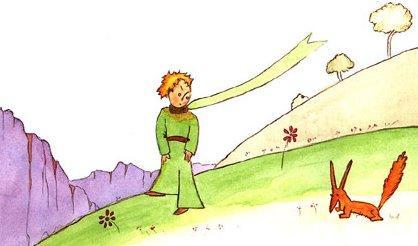


In The Little Prince, the little prince comes into contact with many characters while he is visiting Earth. All the characters the little prince encounters openly explain to him everything about their lives. The little prince finds that on Earth, all true meanings are hidden. The little prince, on the other hand, acknowledges that the most important qualities in life are invisible and mysterious. He constantly asks questions instead of giving answers. This is similar to how Pearl questioned Hester about the scarlet letter and the Black Man. In The Scarlet Letter, Dimmesdale hides the secrecy of sin inside of himself. He too has a mark like Hester. Although he refuses to confess and be punished, his sin ultimately marks his body even more permanently than either Hester's scarlet letter. The scarlet letter can be taken off, but Dimmesdale's mark is with him until he dies. Hester and Dimmesdale chose to keep their sin a secret from others, and both of them suffer because of it, instead of telling the truth. The prince eventually gets bitten by a snake. The snake said that if he was bitten, he would be able to go back to his planet. But, once he gets bitten, he dies. The snake can be compared to Chillingworth since both these characters trick another character. The little prince and Dimmesdale eventually die because of the trickery.



Birdman or (Dimmesdale Finally Grows a Backbone)

Hawthorne ends his novel the same way he begins it: at the marketplace. This time, the Puritans are celebrating the inculcation of a new governor by throwing the wildest parade they can muster, which turns out to be a pretty solemn event. Meanwhile, Dimmesdale is delivering an energetic sermon about the relationship between God and man’s communities. Dimmesdale seems to use up all of his remaining life force on this sermon: Hawthorne does his best to paint Dimmesdale after his speech as a corpse just waiting to fall over, signifying that his time is soon; the burden of his sin is too great. Sensing this, Dimmesdale beckons Hester and Pearl to join him atop the scaffold so that they can exist as a family if just for a brief moment in time. Of course, Chillingworth wouldn’t be Chillingworth if he didn’t find a way to ruin the moment, and so he emerges from the crowd and calls for Dimmesdale to abandon Hester in his final moments, that he might not “perish in dishonor” (225). Dimmesdale, actually showing a backbone for once, retorts, saying, “Methinks thou are too late!” (225). This line is crucial to Dimmesdale’s integrity as a character: for one thing, Hawthorne lets him do something besides begging for Hester’s strength like a four-year-old asking his Mom if he can have a toy from the toy store. For another, Dimmesdale finds it in himself to accept that he has sinned, and as soon as he is able to do so, he finds the strength which he has begged Hester for within himself. He removes the bandage covering his chest in front of the entire Puritan community and announces both to his people and to God that he is in fact the Monica Lewinsky to Hester’s Bill Clinton. Once Dimmesdale has openly admitted his own sin, the evil is sucked out of Chillingworth, and he is left on his knees, repeating, “Thou hast escaped me!” Dimmesdale asks that God forgive Chillingworth, himself and Hester, and then dies.
Hawthorne then brings us quite some time into the future, after Chillingworth has kindly left Pearl a great deal of property before passing away himself. Not surprisingly, Pearl’s social status is elevated immediately. Hawthorne goes so far as to say that her people’s forgiveness would allow her to marry even the purest of the Puritans, although the language used in describing her actual fate is intentionally vague and suggests that she never married. We’re then told that Hester Prynne has returned to Salem and now spends her days giving her counsel to others, mostly women, in need of her strength. Finally, Hawthorne shows us the shared gravesite of Hester and Dimmesdale, engraved “On a field, sable, the Letter A, gules” (235). Sable refers to a very dark black, and gules refer to the color red, so the whole epitaph means “on a field of black, the letter A in scarlet.” Thus, Hawthorne wraps up his novel in a pretty bow.
Now, Mr. Mahoney has asked me to stop “dumping on Hawthorne,” so I won’t discuss his blatant declaration of the theme of his own novel. Instead, I’ll discuss a much more ambiguous piece of art with similar themes: Alejandro G. Iñárritu’s film Birdman or (The Unexpected Virtue of Ignorance). Much like Dimmesdale, this film’s protagonist Riggan Thomson is haunted by his past. Riggan spends the entire film desperately trying to separate himself from his role in the fictional comic book film Birdman. As he does this, he is relentlessly tortured by some kind of malevolent force whom we later find out is a manifestation of his own psyche.

Riggin tormenting himself.

Similarly, Dimmesdale is tortured by Chillingworth for most of The Scarlet Letter, but once he is able to master his own psyche and admit to the world that he has sinned, Chillingworth’s torturous powers disappear. Both works end with the main male characters giving a powerful public performance. In The Scarlet Letter, Dimmesdale gives a rousing sermon so strong that it kills him. In Birdman, Riggin faces the realization that he will never achieve his Platonic conception of himself, and so he makes an attempt to kill himself onstage. Only after these public displays of passion can these men connect to their families. Riggin’s daughter is only willing to forgive him for his horrible parenting after his attempted suicide, and Pearl is only willing to kiss Dimmesdale after he has publicly cleansed himself of his sin. In the end, both men seem to die satisfied and glorious deaths, as well. After his original suicide attempt fails, Riggin jumps out of his hospital window. We then see his daughter rush to the window and gaze up at the sky, smiling, as if Riggan has finally risen above his past as he always wanted to. Dimmesdale finds peace in death as well. “Praised be His [God’s] name! His will be done! Farewell!” Dimmesdale faces death with an eery alacrity, having cleared his name to his society and to his Heavenly Father. In the end, both men’s lives symbolize the messages that Hawthorn and Iñárritu fight so hard to get across: with acceptance of the self comes peace.

Saturday, March 7, 2015

Where are the Wild Things?

The Scarlet Letter: The Musical

Introduction to Hawthorne

The Scarlet Letter, complete with its unique style of literary elements and purposeful use of repetitive vocabulary, has set itself up to become a beautiful motion picture. Although it has been directly turned into a film, several movies or plays could be produced using just small sections of this novel. The book easily lends itself to the style of a play. The author's asides would build great suspense in an audience of literary scholars and avid movie-goers alike. The author Nathaniel Hawthorne has an interesting and distinct voice in his writing, as well as an incredible skill of differentiating characters by their dialogue and how they formulate sentences. Chillingworth, for example, uses highfalutin vocabulary as his knowledge is 
superior to all others in the settlement.

Aside

Nathaniel Hawthorne uses a unique literary tactic similar to an aside in a play. He builds suspense through his rhetorical questioning and his giving information to the audience which is unknown to the characters of the novel. He often phrases his asides similar to Disney Channel does before commercials on their shows. During intense or suspenseful scenes, he will cut to an aside to make us, the audience, question the outcome before it is presented. Nathaniel Hawthorne has a characteristic way of setting his novel up for a play or film, and sometimes will hint this to the audience. After Dimmesdale falls to the floor during his final sermon, the major characters surround him.

They beheld the minister, leaning on Hester's shoulder, and supported by her arm around him, approach the scaffold, and ascend its steps; while still the little hand of the sin-born child was clasped in his. Old Roger Chillingworth followed as one intimately connected with the drama of guilt and sorrow in which they had all been actors, and well enticed, therefore, to be present at its closing scene.(Hawthorne, 226)
Roger Chillingworth had felt so connected to the whole drama which was 'The Scarlet Letter' that he both deserved and belonged to be there with them as it unraveled. They were all actors of some sort, either acting outwardly as someone they were not, or thinking inwardly as a different person than they wished to be. Roger Chillingworth is seen by many to be evil or of-the-devil, and is portrayed like this throughout the book. Nevertheless, one of the most important characters of the novel, he would have to be there for the story to be complete. It was his duty to be a part of the closing scene, and had earned it through his 7 years of torture and obsession.

The 'A'

At the end of the novel, Hester returns from England to her cabin in the woods, the abode which humbled her and supported her after the sin. The house, much like Pearl, was a comfort to her, as well as a curse that would remain with her until death. Upon her return, she does not resemble a human, but more of a ghost. This ghost was dressed in the most expensive clothing money could buy, and entered the house in an attempt to be unseen. The ghost represented both her ignominy and her withering beauty and love. After Dimmesdale passed away, Hester had no one to love except for Pearl, who would soon grow up and move out on her own, The lonely Hester Prynne waits for death to once again rejoin her beloved Arthur Dimmesdale.
The detail which seemed the most crucial to the scene was the fact that her A remained on her chest through all these years.
On the threshold she paused,...But her hesitation was only for an instant, though long enough to display a scarlet letter on her breast. / And Hester Prynne had returned, and taken up her long-forsaken shame! (Hawthorne, 233) 
The only time she took it off was in the woods, when she felt free of her sin thanks to Dimmesdale's affection. It was quickly put back on when Pearl begs for it to be put back, as if she could not recognize her mother. The A became a part of Hester, an integral building block of her character. With no further reason to remove the A, it becomes lost in the fabrics of her wealth. The A becomes a birthmark, a mark so important to the identity of a person that is often overlooked by oneself, and over-examined by others. Birthmarks separate identical twins at an age so young they cannot yet open their eyes. The A has become integral part of Hester's identity and will forever remain there until she once again enters the forest with Dimmesdale; whether it be a meeting with Dimmesdale's spirit in the woods, or an everlasting rendezvous in the boundless planes of Heaven.

Where the Wild Things Are

Hester Prynne is lost in a world of sinners. It seems to her as though the inhabitants of the world like to feel higher than others by minimizing their sins and maximizing the sins of others. Hester was able to see the sins of those around her once she put on the A, some sins worse than the one she committed. Hester felt like no matter where she went in the world she would be trapped in the same situation, as people all over the world are very much similar on the inside. The one place she could be alone and be herself was in her cabin on the edge of the woods, where evil supposedly thrived. The Black Man lived in the woods along with Hester and Pearl, and thus these people quickly became associated with each other, despite sharing few common traits. The Black Man was a demonic or Satan-like figure who lived in the woods. It is unclear whether the members of the community actually believed that a Black Man did live out there, or whether this was a figurative being who personified evil and the unknown.
The gossamer thread I found was related to the children's book Where the Wild Things Are. This book was my all-time favorite book as a kid, and my mother would read it to me once a week. My sisters and I even formed a game based off of the book where my father was the monster and we would have to get downstairs and to the base before the monster tagged us.
The main plot of the story is that Max wears his wolf suit and his imagination runs wild. His mother sends him to his room without dinner after he proclaims, "I'll eat you up!" and as he sits there his room becomes a forest of vines and trees. He takes his boat across the water for a year to the place where the wild things are. After controlling them with magic, they have a "wild rumpus" until Max wants to return home because he misses his mother. He sails home after being begged to stay by the monsters and eats the hot dinner his mother prepare for him, "and it was still hot".
Hester can only find solace in her cabin in the woods, as Max only finds solace in the place where the wild things are. They both go to get away from the hate and contempt of others in their society. They both feel as to not fit into their allotted societies and need to get away. Max lives with the monsters who do with him all of the things he wished to do at home but his mother would not let him. Hester lives in the woods which is synonymous with sin, doing whatever she wishes. She can do all of the things that society will not let her do and she finds comfort in the sin and darkness of the woods.
Hester ultimately returns to society by helping those around her in order to appease the societal members and Max comes home to appease his mother. Max wears his wolf suit which signals wildness and barbarous behavior, but blends in with the monsters. Hester wears her scarlet letter, signalling adulterous and sinful behavior, but blends in with the sinners of society.
Hester is labelled the most sinful and all other sinners look to her as the most sinful in order to make themselves feel better. Max, on the other hand, becomes king of the monsters, ultimately putting him in the same spot as Hester. The monsters worship Max as their king, as the sinners inwardly worship Hester, as she makes them look better.
Finally, Max ultimately leaves as his place in the society, the king of bad things, does not make him happy, and needs society and love to be happy. Hester dislikes being the worst societal member (by societal standards) and works herself back into society to feel loved and worthy.


Wednesday, March 4, 2015

Rad


In the beginning of the novel, Hester comes out of the jail beautiful as ever even though she had just given birth. She came forward from the prison full of dignity as if walking out was her own choice. Standing tall and elegant with her thick black hair shining in the sunlight she stood dignified with a proud smile on her face. As time passes, Hester is no longer the powerful individualistic person that she was before. Her beautiful hair is cut short and hidden by a cap and any physical aspects of her have been washed out.

"On this public holiday, as on all other occasions, for seven years past, Hester was clad in a garment of coarse gray cloth. Not more by its hue than by some indescribable peculiarity in its fashion, it had the effect of making her fade personally out of sight and outline; while, again, the scarlet letter brought her back from this twilight indistinctness, and revealed her under the moral aspect of its own illumination. Her face, so long familiar to the townspeople, showed the marble quietude which they were accustomed to behold there. It was like a mask; or rather, like the frozen calmness of a dead woman’s features; owing this dreary resemblance to the fact that Hester was actually dead, in respect to any claim of sympathy, and had departed out of the world with which she still seemed to mingle." (Hawthorne 203)

Wearing of the A and carrying the burden her sin has exhausted Hester. She spent many years trying to recover and fit in society once more. This effort transformed her into someone who she is not. On the outside she is simply following guidelines to fit in society, going through the motions she does not care for. In her heart Hester is miserable but is doing what she has to do for her sin because it is penance and it is what the Puritan people wanted from her.

Later Hester is compared with how her daughter Pearl is dress:
"Pearl was decked out with airy gayety. It would have been impossible to guess that this bright and sunny apparition owed its existence to the shape of gloomy gray; or that a fancy, at once so gorgeous and so delicate as must have been requisite to contrive the child’s apparel, was the same that had achieved a task perhaps more difficult, in imparting so distinct a peculiarity to Hester’s simple robe." (Hawthorne 204)

While her mother was dress in a bland grey attire, Pearl was dressed in light happy clothes. It is stated that it would have been extremely difficult to think her mother was Hester, who is sporting the complete opposite of what her daughter is wearing. Pearl is a very nimble and intelligent child who has the same confidence that her mother had earlier. The dress that she wears suits her well in the fact that it makes her seem like she is one with nature.

It seems as Pearl grows older and the longer Hester bears her sin the less of an individual she becomes and tries her hardest to fit back in with the Puritan society for the sake of her daughter. But as she is doing this, Pearl is wild and unique as Hester was when her sin was new.

I compared this transformation with two of Willian-Adolphe Bouguereau's paintings. Although is he most known for his classical paintings of women, he painted two Christian Marion paintings. One showing the popular image of Madonna and child and the other being the image of the Pieta.


The first painting Madonna of the lilies represents Hester standing on the scaffold with Pearl and also her sin. You can see that her face is showing little emotion and does not show any sort of shame and she ignores eye contact with the viewer. If there baby were to represent her sin it is new and easy to hold and has not burdened her yet. There are also flowers around her (not roses but hey) representing the wild and sin. The second picture shows the scene of the Pieta which is Mary cradling the dead body of Jesus. In this painting the colors are darker and Mary is facing the viewer with a face of distress. Next in the sequence of Marian art comes the depiction of Mary as Our Lady of Sorrows. Definitely in this painting  Mary/Hester is sorrowful. Let's call Mary Hester and Jesus her sin. In this painting jesus/her sin is older and she has been with it longer. Hester is burdened with carrying this load. The angels around her can be depicted as the Puritans. Some refuse to acknowledge her, some feel pity for her and are ready to take the load/ A off of her and others are still aggressive.


The Futile Attempts of Restraining Emotions: Chapters 20-22

In Chapters 20-22, Dimmesdale undergoes a major change in his life, for he is now living a new life in his mind. He starts out very happy early in Chapter 20. Dimmesdale has a family, a new life waiting for him in Europe, and an opportunity to end in ministerial career in the New World with a bang. This gives him great joy and so as he walks back into town, his newfound emotions flow through his soul, ready to break through the walls he created in his mind to keep his real emotional life from bursting out. This contributes to what I think is a major motif in the novel, emotional restraint/control. He is barely able to contain his emotions now, as shown when he was attempting to converse with a deacon from his church:

“Now, during a conversation of some two or three moments between the Reverend Mr. Dimmesdale and this excellent and hoary-bearded deacon, it was only by the most careful self-control that the former could refrain from uttering certain blasphemous suggestions that rose into his mind, respecting the communion-supper. He absolutely trembled and turned pale as ashes, lest his tongue should wag itself, in utterance of these horrible matters, and plead his own consent for so doing, without his having fairly given it.” (Hawthorne 195-6)

Dimmesdale clearly is not able to control his inner feelings like a proud, emotionally withholding graduate of Oxford University would. He goes on to almost blurt blasphemous words to an elderly women, to ignore a young convert, and to almost teaching a group of young children some very bad words.

However, as Dimmesdale himself remarks, he is no longer that person:

“‘I am not the man for whom you take me! I left him yonder in the forest, withdrawn into a secret dell, by a mossy tree-trunk, and near a melancholy brook! Go, seek your minister, and see if his emaciated figure, his thin cheek, his white, heavy, pain-wrinkled brow, be not flung down there like a cast-off garment!” (Hawthorne 195)

I personally think that this new Dimmesdale is not going to be permanent. Everything seems too good to be true, and because this chapter and the two others after are building up to Dimmesdale’s Election Sermon, all of this foreshadows that something unfortunate will happen to Dimmesdale during his Sermon. Dimmesdale rips up the Sermon he had already written because it was written by the old Dimmesdale. He creates a new Sermon written by the new Dimmesdale, one that had “an impulsive flow of thought and emotion”. His encounters with the townspeople show that he is on the verge of revealing his inner mind, and so we can assume that his Sermon will reveal all of these things. The punishment of Dimmesdale’s failure to restrain his emotion will be revealed in his Sermon.

Hester and Pearl both contributed to the motif of emotional restraint in Chapters 20-22. The pompous and flamboyant Puritan procession, which may be Hawthorne’s social criticism, can also be interpreted as part of the motif of emotional restraint. Hester, like Dimmesdale in the previous chapter, is happy during the start of the procession, for her emotions are flowing yet again:
“It might be, on this one day, that there was an expression unseen before, nor, indeed, vivid enough to be detected now; unless some preternaturally gifted observer should have first read the heart, and have afterwards sought a corresponding development in the countenance and mien. Such a spiritual seer might have conceived, that, after sustaining the gaze of the multitude through seven miserable years as a necessity, a penance, and something which it was a stern religion to endure, she now, for one last time more, encountered it freely and voluntarily, in order to convert what had so long been agony into a kind of triumph.” (Hawthorne 203)

Hester just can not wait for her move to England. She has the same hopes as Dimmesdale, once she leaves New England, she will be liberated. These are her last few hours with the Scarlet Letter. She believes she has triumphed through years of agony, and soon, “the deep, mysterious ocean will quench and hide forever the symbol [The Scarlet Letter]”. Hester, who is not in the same mental state as Dimmesdale, is able to contain her emotions more properly, but a “preternaturally gifted observer” can tell that she also is having trouble restraining her happy emotions.

Emotional restraint can be a requirement for some jobs, perhaps most important for spies. Hester and Dimmesdale wanting a future together reminded me of the spy comedy-drama Chuck. In this TV show, the nerdy, Stanford dropout main character Chuck Bartowski accidentally downloads all government secrets into his head. The NSA and CIA both send their agent to make sure the information stays safe. The CIA agent, Sarah Walker, develops feelings for him. However, since her job is to protect the information in his head, she has to restrain her feelings for him. Chuck obviously develops feelings for her as well, but he knows that she will be reassigned if her superiors find out. At the end of the second season, both Chuck and Sarah decide that they should just run away from the CIA and live with each other traveling across Europe.
This is very similar to Hester and Dimmesdale, although Chuck and Sarah are much more romantically involved. The professions of both Dimmesdale and Sarah require them to restrain their own personal emotions. Dimmesdale does this for the good of religion, while Sarah does this to protect her country. Hester and Chuck are harder to compare with each other, but both characters have been punished for a seemingly innocent crime, but still have great potential. Hester is a master embroider who gets publicly shamed for adultery. Chuck is a master hacker/computer specialist who gets kicked out of Stanford (and also publicly shamed for he was forced to walk out of Stanford with a crowd watching him) for something that was not his fault. Hester causes Dimmesdale to have trouble restraining his emotions, which changes Dimmesdale entirely. Both of them want to break with their culture after this. The same thing almost happens in Chuck. Both Sarah changes Chuck from a harmless nerd in the first season to a superspy in the final season. The same way Hester changes Dimmesdale, Chuck causes Sarah to change from a coldhearted spy to a happily married wife.


Civilization, Wilderness, and the Happy Medium


http://d75822.medialib.glogster.com/ccaldwell96/media/b6/b60cd0c1ad5f0087263b023082ea27a11c553ee3/awakening-savage-umbrella-2.jpg
In The Awakening, by Kate Chopin, when Edna Pontillier embraces her impulses and wild nature, she is rejected and despised by civilized society. Edna is not a manifestation of evil or sin; she is simply a woman clumsily liberating herself from a repressive society. Edna, like Pearl, is described as a bird, soaring over the sea, braving unknown territory. Edna, like Dimmesdale, is freed from an oppressive society by escaping into the ocean and thus begins a grueling crusade toward self-discovery and individuality. While Edna, Hester, and Pearl find solitude and public shame a consequence of this independence, they are only true to themselves when they diverge from civilization. Thus, to discover one's true, uninhibited identity, one must first outgrow civilization and embrace passion.

http://upload.wikimedia.org/wikipedia/commons/0/02/Rocky_Cliff_with_Stormy_Sea_Cornwall-William_Trost_Richards-1902.jpg The Puritans feared the expansive, untamed, unknown, uncivilized wilderness that encircled their small communities. They believed that the forest, populated by "uncivilized heathens" and the cunning "Black Man", radiated evil. Mariners, inhabiting the turbulent sea, were likewise viewed as lawless beings. Symbolically, the forest and ocean represent the emotional, passionate, and impulsive elements of human nature which Puritans suppressed in an attempt to appear wholly pure and predestined for Heaven. The Puritan elders, "stood up for the welfare of the state like a line of cliffs against a tempestuous tide" (Hawthorne 213). Thus, the elders upheld the strict customs, laws, and practices of the Puritans by repressing passion, ostracizing subversives, and crushing human creativity and individuality.

Freed from this repression and judgment, woodland wanderers could temporarily indulge themselves in an alternate identity without fear of punishment. Dimmesdale emerges from the woods an altogether different and more animated man scarcely able to suppress a multitude of wicked impulses. His uncharacteristically malevolent inclinations, freed by wilderness, are the culmination of years of pent up negativity, harmless pranks, and minor transgressions. Human nature is a composite,a balance between sin and purity, between passion and restraint, that varies minutely by individual. Humans cannot, through a conscious effort, simply expel half of their innate sentiments. Struggling to reconcile his exploding passions with his role as a Puritan minister, Dimmesdale flickers between the extremities of Satan's lively henchman or a saint on Earth, owning his sin and accepting Pearl or masking it and ignoring her. Returning to his study from in a wild, impassioned state, Dimmesdale's entire Election Sermon flowed effortlessly from his fickle mind to the parchment. On the Election Day, Dimmesdale maintains an unattainable, vacant, and unrecognizable demeanor, but throughout his impassioned sermon, Hester detects an anguished undercurrent:

"even when the minister's voice grew high and commanding,- when it gushed irrepressibly upward,- when it assumed its utmost breadth and power, so overfilling the church as to burst its way through the solid walls and diffuse itself in the open air,- still, if the auditor listened intently, and for the purpose, he could detect the same cry of pain. What was it? The complaint of a human heart, sorrow-laden, perchance guilty, telling its secret, whether of guilt or sorrow, to the great heart of mankind; beseeching its sympathy or forgiveness,- at every moment,- in each accent,- and never in vain! It was this profound and continual undertone that gave the clergyman his most appropriate power" (Hawthorne 217-218).

Dimmesdale channels his inner turmoil into his words, releasing so much powerful emotion that the walls of the rigid Puritan church cannot contain his energy. The minister is thus reinvigorated by the forest both physically and mentally, expanding beyond Puritan constraints on individuals' passion and emotion.

On Election Day, Hawthorne portrays Pearl as a restless, effervescent bird of the sea, the manifestation of wild passion and impulses, to display Hester's internal emotions. The Native Americans recognize that Pearl is wilder, and the mariners fancy her a brilliant token of the sea. Hester and Pearl's close proximity to the forest illustrates their divergence from Puritan civilization. Pearl is simultaneously a blessing, symbolizing Hester's passion and vitality, and a living manifestation of the scarlet letter, representing sin and shame. Living beyond the reach of the human regulations, the mariners have a permanent "animal ferocity" and "transgress, without fear or scruple, the rules of behavior that were binding on all others," yet could in an instant become reputable Puritans (Hawthorne 208). After half a lifetime of barbarity at sea, free from restraint and organization, a sailor could, like Dimmesdale, unleash an alternate personality in which he embraced Puritan structure. In contrast, Pearl is ruled by her wild impulses and innately contains a spirit of passion and emotion that is nearly irreconcilable with Puritan piety. Hester protects her wild daughter through the repression of her own defiant character, performing charitable duties, repenting her sin, and behaving and dressing as a devout Puritan would. At the procession for Election Day, Pearl, with her erratic movements and shrieks, manifests Hester's growing internal agitation and the passion bubbling beneath her mother's stony composure.

Thus, Hester is the bridge uniting the more extreme Dimmesdale and Pearl with her instinctive strength and self-confidence. Hawthorne builds suspense regarding a tortured and conforming Dimmesdale's capacity to assert his composite nature under public scrutiny. If Dimmesdale diverges from the well-worn path of civilization, he will simultaneously begin the turbulent process of self-discovery and plummet, in the eyes of his congregation, from the highest angel to an adulterous sinner. Only after outwardly owning his sin and escaping the gauntlet of public shame could Dimmesdale attempt to arbitrate a composite of his extreme identities as Hester had done. Ultimately, Nathaniel Hawthorne was a writer haunted by his ancestor’s role in the Salem Witch Trials and therefore criticized Puritans' strict repression of human nature. He develops this cricism extensively in chapters twenty through twenty-two of The Scarlet Letter by intensifying Pearl, Hester, and Dimmesdale's struggle to balance civilization and wilderness and thus embrace human nature.