
In my opinion The Scarlet Letter finally begins to get
exciting during the chapters 9-12. For me, the highlights of theses chapters
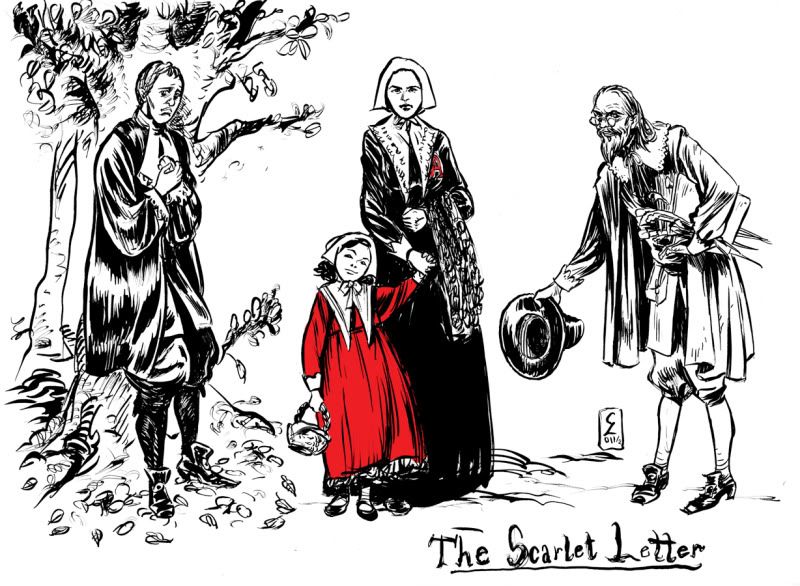
are Chillingworth’s attempt at finding out Dimmsdale’s secret, and Pearl’s omniscient
abilities. In these chapters the reader begins to understand the evil fire that
began brewing in Chillingworth when he first saw Hester on the scaffold. In the
eyes of the townspeople Dimmsdale is godlike, and similar to Jesus. On the
other hand many townspeople are skeptical of Chillingworth and many see him as
Satan’s servant. Chillingworth has become a well respected physician, and is asked to live with and treat Dimmsdale as
Dimmsdale grows sick. The Townspeople view this arrangement
as a trial for Dimmsdale to overcome the evil Chillingworth. I find the image
of a holy figure fighting a devilish figure to be very similar to Adam and the
snake or Jesus being tempted by the devil.
As he spends time with Dimmsdale, Chillingworth uses his
finely tuned traits as a physician to diagnose Dimmsdale’s sickness. However,
during this process, Chillingworth’s morally ethical practice falls to ruin as
he begins to desire the manipulation of Dimmsdale. Hawthorne describes this
process in which Chillingworth goes about delving into Dimmsdale:
“He groped along as stealthily, with as cautious a tread,
and as wary an outlook, as a thief
entering a chamber where a man lies half asleep, -or, if it may be, broad awake, -with the purpose to steal
the very treasure which this man guards as the apple
of his eye. In spite of his premeditated carefulness, the floor would now and then creak; his garments would
rustle; the shadow of his presence, in a forbidden proximity, would be across the victim” (Hawthorne 118).
I find the comparisons and the irony in this passage
very interesting. Hawthorne describes Chillingworth to be a “cautious” and
“stealthy” “thief”. Chillingworth is most definitely a thief because he is
trying to steal Dimmsdale’s secrets and subsequently steal his freedom for, if
the thieving is successful, Chillingworth will be able to reveal the secret
that formerly could only have been revealed by Dimmsdale. However, leading up
to this point in the novel, Chillingworth has not been very stealthy. When he
asks Hester who Pearl's father is he cannot conceal
the mischievous look on his face even though doing so may have
influenced Hester to divulge the information. However,
when committing the act of thieving Chillingworth is able to conceal
his true intentions. Although Pearl and the meteor do reveal Chillingworth's true identity. This leads me to question what Dimmsdale thinks of Chillingworth. Chillingworth wants to steal Dimmsdale’s secret or in
this case, the “apple of his eye” and rob him of his identity. I find this
ironic because Chillingworth previously had his wife, a prized possession,
stolen away by Dimmsdale’s adultery, which subsequently forced Chillingworth to
change his identity completely to avoid the following shame if his identity was
discovered. This passage in general interested me because of the portrayal of Chillingworth and made me question how affective Chillingworth's disguise was.
The next highlight in the
chapter for me was Pearl making an appearance during a conversation between
Chillingworth and Dimmsdale. As the two men were talking and looking out over
the graveyard they notice Pearl skipping amongst the tombstones with her mother
in the distance. The men talk about Pearl causing her to look at them. Pearl
says to Hester “Come way mother! Come away, or yonder old Black Man will catch
you! He hath got hold of the minister already. Come away, mother, or he will
catch you! But he cannot catch little Pearl!” (Hawthorne 122). In this moment
Pearl serves as an angel of sorts to her mother but also as a messenger of the
truth. She is there to warn her mother and protect her from Satan, just as
angels do. She also serves as the truth because she can see the evil through
Chillingworth’s guise. Later in the text when Dimmsdale is on the scaffold with
Hester and Pearl and pretends to be confessing his secret to the townspeople Pearl
reminds him of the truth. She does not indulge in his dreams but instead asks
him if he will be on the scaffolding at noon with Hester and her. This jolts
Dimmsdale back into reality and reminds him of his faults and the truth that he
is too weak to confess his secret. In both instances Pearl represents the truth and is able
to focus on reality amidst illusions.
This reminded me of Biff Loman. As we all
know, in the play The Death of a Salesman Biff serves as the face of
reality. As the play develops Biff becomes more and more in tune with reality.
Near the end of the play Biff can see through the lies that Happy tells the
family and no longer allows Willy to live in his dream world. This is similar
to how Pearl sees reality through Chillingworth’s lies and prevents Dimmsdale
from living in his dreams After finally coming in touch with reality completely
Biff no longer tries to force himself to be a businessman. Instead he can
finally do what he wants and work and live outside. Pearl acts similarly. She
is born in touch with reality and acts in any way she wants regardless of what
the other children do. This connection helps me realize how Pearl can be a positive character similar to Biff instead of the evil imp creature she is made out to be.


I really liked your connection to Death of a Salesman. I didn't see the connection at first, but when you pointed it out, I realized how similar Biff and Pearl are to each other. Both of them bring reality to the illusion of the others around them, and thus inspire them to make a change in themselves. This idea of how the imp-child Pearl could be a blessing as well connects to a scene in an earlier chapter, when the governor's sister is trying to convince Hester to join a witches' gathering. Hester refused, citing her possession of Pearl as the reason why she does not decide to stray to the dark path, showing, just like in this scene, how Pearl can be of benefit instead of harm.
ReplyDeleteI agree that the comparisons and irony in the passage were very interesting, as there there are many contrasting details between Chillingworth and Dimmesdale. I felt like it added a depth to the characters, and there was definitely character development in those characters from the beginning to the current chapters; Dimmesdale becoming a sin-filled shell of himself, and Chillingworth becoming more evil. I also agree with your observation that Chillingworth's morals as a doctor begin to fail as he starts to involve himself in Dimmesdale's business.
ReplyDeleteI really loved your connection between Pearl and Biff. The similarities between the two are not as blatantly obvious in the text, but when you described them during the class discussion, I agree with Mr. Mahoney's statement that it was an ah-ha moment for a lot of us, myself included. I also agree that Pearl embodies truth as she sees through Chillingworth and warns her mother. During my reading of the chapters that was a quality that stood out to me as well.
ReplyDeleteThis connection is really impressive! It was kind of shocking when you first said that this was your connection, but it really took the class to a deeper analysis of Pearl's role in the plot. This connection can help us predict what Pearl's role may be in the future. This connection really helped me understand the significance of Pearl, and I'm interested to see if this connection will remain strong as we continue to read the novel.
ReplyDelete