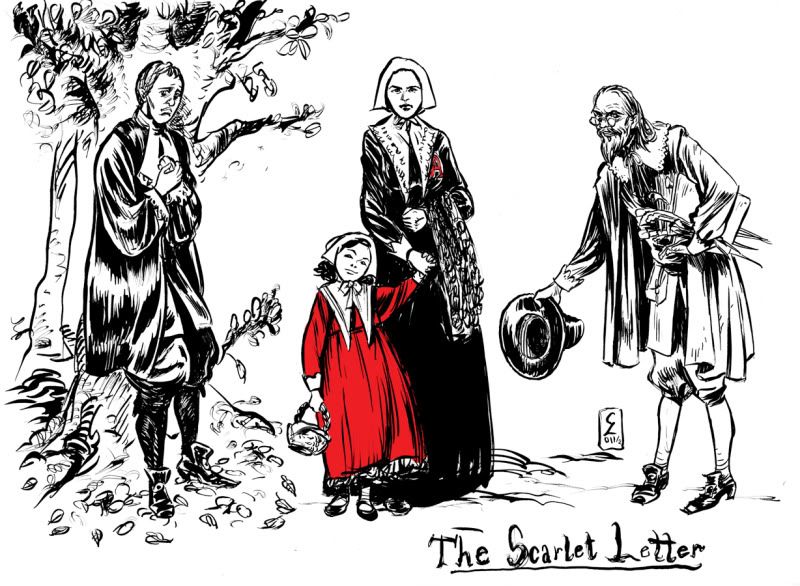
As Hester undergoes this transformation, so to does the symbol of the scarlet letter. Rather than standing for Adulterer, it now stands for Able. Many also believe it to be sacred, describing, "the scarlet letter had the effect of a cross on a nun's bosom. It imparted to the wearer a kind of sacredness, which enabled her to walk securely amid all peril," (Hawthorne 148). The scarlet A bears a symbolic likeness to the crucifix in Christianity. The cross was once a symbol for sin, as convicted criminals would be put to death by crucifixion. However, after the death of Jesus Christ, the cross became a sacred symbol, reminding Christians how Jesus died to save the sinners. The scarlet letter, similarly, was once a symbol of Hester's sin and a reason for her shame, but then became a sacred symbol within the society. In a novel written about a Christian society, it is unlikely that this parallel was an accident, but since Hawthorne never explicitly states this parallelism and never takes an aside to flaunt his use of a biblical allusion, it is much more subtle than his other literary devices. In contrast to the reverence with which the public views the scarlet letter as a source of strength, the reader may view the scarlet letter as a leech of her power and grace. Hawthorne describes, "All the light and graceful foliage of her character had been withered away by this red-hot brand, and had long ago fallen away, leaving a bare and harsh outline, which might have been repulsive, had she possessed friends or companions to be repelled by it," (Hawthorne 148). This transformation, although uplifting her reputation in society, ravages the qualities that were at the beginning of the novel characteristic of Hester. Her luscious hair, her rebellious personality, and her passion are now gone, leaving only a shell of a person. Although these changes were for the good of Pearl, as a reader it is difficult, and almost pathetic, to watch as any hopes of Hester leading the Puritans away from hypocrisy and into salvation, are torn away.
Possibly even more pessimistic is the transformation of Chillingworth. The scholarly figure presented at the beginning of the novel has been slowly transforming into a grotesque, demonic, or devil like figure. What began as Chillingworth's quest for justice against Dimmesdale transformed into a thirst for suffering. Chillingworth is addicted the pain of Dimmesdale, feeding off this suffering like the leech he is associated with. Without even noticing, Chillingworth descends further and further into this masochistic obsession. Finally, in a confrontation with Hester, Chillingworth is able to view himself through outside eyes, and sees himself become a villain. Even so, he refuses to take responsibility for his actions, attributing them to Providence or a natural course of the universe, stating "Let the black flower blossom as it may!" (Hawthorne 157). Chillingworth, upon seeing the evil inside himself, throws up his hands in defeat and says to let evil do as it may. Like Dimmesdale when conflicted over revealing his guilt, Chillingworth puts his destiny in the hands of the universe. Chillingworth's descent into cruelty and apathetic reaction to this descent adds to the pessimism in these chapters.
Chapters 13-15 draw some parallels to popular culture. Firstly, both Hester and Chillingworth's descents into darkness remind me a of quote by Roald Dahl. This quote from Matilda, and discusses the idea that thoughts and actions can cause physical changes.


This concept is reflected most in Chillingworth. As he hurts Dimmesdale more and more, becoming more and more evil, his appearance becomes more and more grotesque. His complexion darkens and his deformity worsens until he not only looks like a villain, but also like the devil, or Black Man, himself.
After Chillingworth and Hester have a conversation, Hester questions as to why she ever married such an evil man. This scene reminded me of a story from Greek myth about Hades and Persephone. According to legend, Hades the god of the underworld kidnapped Persephone because of her beauty and forced her to live with him in the underworld. Similarly, Chillingworth was enamored with Hester's beauty, and though she was much younger than he and did not love him, he convinced her to get married anyway. In the myth, before Persephone can be rescued, she is tempted into eating pomegranate seeds. In order for her to return to Earth, she must be pure, but because she tasted the fruit of life and is stained with the the ruby juice, she can not escape. Hester, likewise, is tempted into sinning, and as a result stained with scarlet and sentenced to an eternity in hell.
My last gossamer thread is to the Hunger Games. Like Hester at the beginning of the novel, Katniss is a rebellious character with the potential to transform her society. She sacrifices much for her friends and family, including voluntarily risking her life. Hester, likewise, sacrifices her life for Pearl. Both characters are also ultimately forced to cede to society in order to protect family, giving up their destinies as saviors.